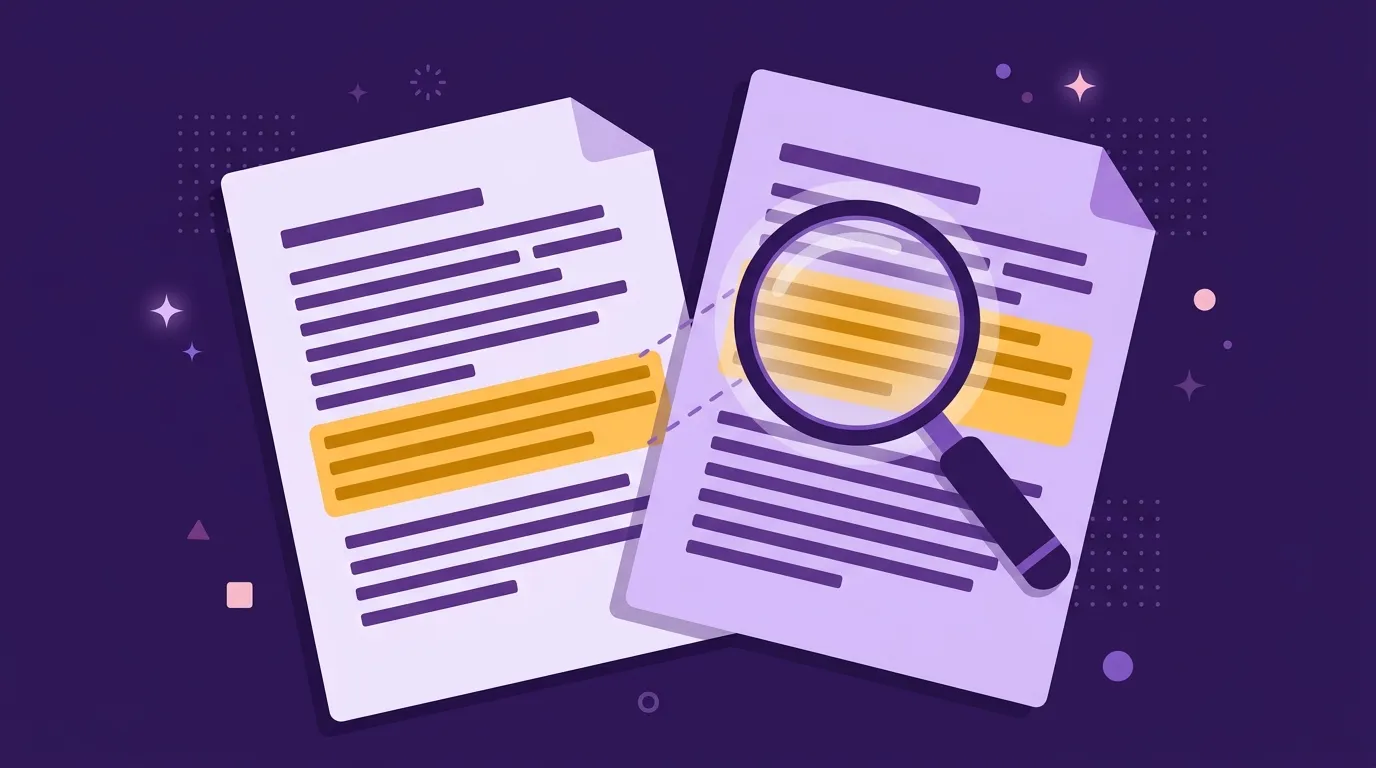
A freelance writer once delivered me a "100% original" article that felt weirdly familiar. Ten minutes later I found my own competitor's post wearing a thesaurus as a disguise. That afternoon taught me something every editor, teacher, and content buyer eventually learns: you cannot eyeball duplication. Human brains are terrible at judging how much of text B came from text A — but math is excellent at it. Here is how similarity scoring actually works, and how to use it without fooling yourself.
The Number That Matters (and the Two Behind It)
Our checker blends two classic measures. Jaccard similarity asks: of all unique words across both texts, what fraction appears in both? It is length-proof and brutally honest about shared vocabulary. Bigram Dice asks a harder question: how many adjacent word pairs match? That catches copied phrasing even after synonym swaps, because rewording one word in five still leaves most pairs intact. The final score weights sequence matching higher, which mirrors how you would judge it yourself: shared ideas are fine, shared sentences are not.
Reading the Percentage Like a Pro
- 80%+: near-duplication. Same text with cosmetic edits. Reject, rewrite, or cite.
- 50–80%: significant shared passages hiding among original ones. Read the highlighted keywords — they point straight at the borrowed sections.
- 25–50%: common phrasing, shared topic vocabulary, possibly a shared source both writers used. Usually innocent, occasionally lazy.
- Under 25%: independent writing. Even two essays on the same topic rarely clear this bar by accident.
Why Clever Paraphrase Still Gets Caught
Swapping every fifth word feels like rewriting, but bigrams betray it: "the quick brown fox" → "the fast brown fox" keeps two of three pairs. Real rewriting restructures — new sentence order, merged ideas, different examples — and the sequence score craters immediately. I have watched students discover this the fun way: the ones who actually rewrote scored under 15%, and the thesaurus crowd sat stubbornly at 60%+. The algorithm, annoying as it feels when you are on the receiving end, is basically fair.
Similarity FAQs
Does this replace Turnitin?
No, and it does not pretend to. This compares two texts you supply; it cannot crawl the web or academic databases. Use it for writer-vs-writer and draft-vs-source checks, then spot-check suspicious sentences in quotes on a search engine for the internet half.
Can quotes and citations inflate the score?
Yes — long quoted passages count as overlap, correctly. Strip block quotes before comparing if you want the originality of the surrounding prose measured cleanly.
Is my content uploaded anywhere?
Never. Tokenizing and scoring run in page JavaScript. Essays, client drafts, and manuscripts stay on your machine, which matters a lot when the text is under NDA or embargo.
Got two texts and a suspicion? Settle it in seconds.
Compare Texts Free